Interfaces
The chemistry occurring at the interface between two different materials strongly governs the performance of most devices but is often difficult to probe at the experimental level. This is an area where quantum chemistry can play a major role by shedding light on interfacial structural and electronic processes and by estimating quantities such as adhesion energy or diffusion barriers during film growth.
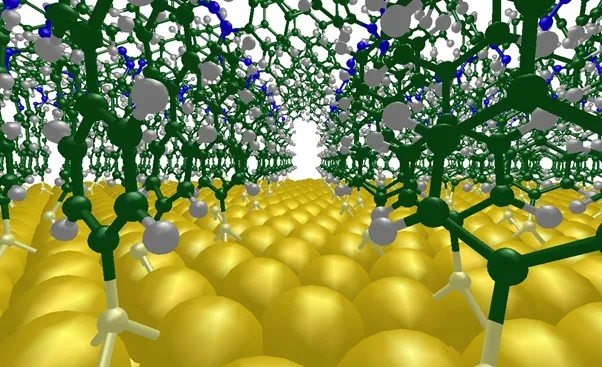
At CMN, we use DFT approaches in conjunction with periodic boundary conditions to build two-dimensional slabs as a central platform for the study of interfaces obtained by depositing next another slab or discrete molecules). This has been applied in many different areas such as organic/organic interfaces in solar cells, metal/oxide in glass formulation, or metal/molecule for charge injection from electrodes. This is also extended to the field of molecular electronics where self-assembled monolayers are sandwiched between two electrodes to generate nanoscale electronic components.